Kofi Annan Great Tragedy Most Vulnerable Human Family
Nosotros may accept different religions, different languages, dissimilar colored peel, but we all belong to one homo race. We all share the same basic values.
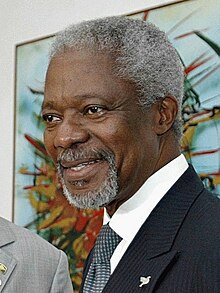
Kofi Atta Annan (eight April 1938 – 18 August 2018) was a Ghanaian diplomat who served equally the seventh Secretarial assistant-General of the United Nations from January 1997 to December 2006. Annan and the Un were the co-recipients of the 2001 Nobel Peace Prize.
Quotes [edit]

Y'all can exercise a lot with diplomacy, only with diplomacy backed up by strength y'all can become a lot more done.
More than than ever before in human history, we share a common destiny. Nosotros can master it simply if nosotros face it together. And that, my friends, is why we accept the United Nations.
We need to create a world that is equitable, that is stable and a earth where nosotros bear in listen the needs of others, and non simply what nosotros need immediately. We are all in the same boat.
- You can exercise a lot with diplomacy, but with diplomacy backed up by forcefulness yous tin can get a lot more done.
- Press conference regarding the employ of force to gain compliance from Saddam Hussein (24 Feb 1998)
- Eradication of extreme poverty has been identified as a priority, and specific targets have been set for prescribed measures. Many said the potential benefits of globalization are understood but people have nevertheless to experience them. Information technology is agreed that part of the solution lies in sovereign States giving priority to the needs of their people, specially the poorest. States, however, must work with the private sector and civil gild to solve the problems of globalization. A more equitable world economy has been called for, one where those who have more do more for those who accept less.
- Address given at the United Nation's General Associates Millennium Summit (8 September 2000)
- I think that my darkest moment was the Iraq war, and the fact that we could non finish it.. I worked very hard — I was working the phone, talking to leaders around the earth... The U.S. did not have the support in the [UN] Security Council. So they decided to go without the council. But I recall the council was right in not sanctioning the war...Could you lot imagine if the U.North. had endorsed the state of war in Iraq, what our reputation would be like? Although at that point, President (George W.) Bush said the U.N. was headed toward irrelevance, because we had not supported the war. But now nosotros know improve.
- Quoted in Kofi Annan, sometime Un secretary general, dies aged 80 (CNBC) (eighteen August 2018)
- He is very calm—very, very at-home. Never raises his vocalization. Well-informed, contrary to the sense outside that he is ill-informed and isolated. And decisive.
- On Saddam Hussein, Press conference (24 February 1998)
- Unless the Security Quango is restored to its pre-eminent position equally the sole source of legitimacy on the apply of strength, we are on a unsafe path to chaos.
- Speech communication at the centennial of the International Peace Conference (nineteen May 1999)
- We may have dissimilar religions, unlike languages, different colored peel, but we all vest to ane human race. We all share the same basic values.
- As quoted in Simply Living: The Spirit of the Indigenous People (1999) edited by Shirley A. Jones
- More than than e'er earlier in human being history, we share a common destiny. We can main it only if nosotros face information technology together. And that, my friends, is why nosotros take the United nations.
- Message for the new millennium (31 Dec 1999)
- You have said that your first priority is the eradication of extreme poverty.
- So spoke United Nations Secretarial assistant-General Kofi Annan on September eight, 2000, to an associates of the world's most powerful men and women. WOL
- I hope we practise not run across another Iraq-type operation for a long time — without UN approval and much broader back up from the international community.
- "Republic of iraq state of war illegal, says Annan" BBC News (16 September 2004); when asked if the invasion of Iraq was illegal, he replied "Aye, if you wish. I have indicated it was not in conformity with the UN lease from our point of view, from the charter point of view, it was illegal."
- Well, the issue of a standing United nations army has been raised by many because, quite bluntly, the mode nosotros operate today is like telling Ottawa that I know you need a fire station simply nosotros will build 1 when the burn breaks. Nosotros accept no army. When the crisis breaks and then we begin to put an regular army together. We become effectually to governments and begin asking for troops. The question with a standing UN army is that it raises bug of budget issues, legal bug, where do you place it, under what jurisdiction? And the large boys, big countries don't desire information technology. The smaller countries are besides nervous.
- These values: compassion; solidarity; respect for each other - already be in all our great religions. We can brainstorm by reaffirming and demonstrating that the problem is not the Koran, nor the Torah nor the Bible. As I have often said, the problem is never the faith. It is the faithful, and how nosotros behave towards each other. Information technology is these not bad, indelible and universal principles which are besides enshrined in the Lease of the United Nations and the Universal Declaration of Human Rights. Nosotros tin utilise these values – and the frameworks and tools we have based on them - to bridge divides and make people experience more than secure and confident of the future.
- Globe Civilisations: "Bridging the World's Divides". Lecture given at the British Museum London.
- The Lord had the wonderful advantage of being able to piece of work solitary.
- Answer when he was asked why he had non yet reformed the U.Northward. an its agencies after five months, given that God had taken only seven days to create the universe. Equally quoted in Time Magazine (1997), edited by Briton Hadden, Henry Robinson Luce. Time Inc. Volume 149. Issues 2-8. p. 24. Besides found in George Antwi (2012), "The Words of Power", Booksmango, p. 103.
- Variant said by Kofi Annan himself during the "Desmond Tutu Annual International Peace Lecture":"Mr. ambassador, you are right. But God had the unique advantage: He worked alone." (He explains that the question was made by the Russian Ambassador of the U.N. at that time).
- The report [by a Un commission on Darfur] demonstrates across all doubt that the last 2 years have been little short of hell on globe for our fellow homo beings in Darfur.
- Annan urges activity to end 'hell on earth' in Darfur (17 Feb 2005)
- The intention was really to practice something dignified, something that is honest and reflects the work that this System does. And it is with that spirit that the producers and the directors approached their work, and I promise you will all agree they accept done that.
- On the motion-picture show The Interpreter, from "Secretary-Full general's press encounter" (19 April 2005)
- Nosotros don't need whatever more promises. We need to start keeping the promises we already made.
- Secretarial assistant-General Kofi Annan'south message for the New Year, 2004. un.org
- There are a great number of peoples who need more than just words of sympathy from the international community. They need a existent and sustained commitment to aid end their cycles of violence, and launch them on a rubber passage to prosperity.
- Watchtower ONLINE LIBRARY, Who Will End Violence?
- The international community . . . allows virtually 3 billion people—near one-half of all humanity—to subsist on $2 or less a day in a world of unprecedented wealth.
- Awake! magazine, May 22, 2002; Can Globalization Really Solve Our Bug?
- We demand to create a world that is equitable, that is stable and a world where we bear in listen the needs of others, and not but what nosotros need immediately. Nosotros are all in the same boat.
- "The World I'm Working To Create", Skoll World Forum (12 August 2013)
Nobel lecture (2001) [edit]
- Nobel lecture, Oslo, Kingdom of norway, (10 December 2001)

In these most basic acts of human nature, humanity knows no divisions.
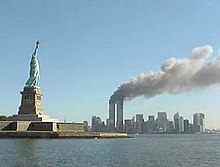
We have entered the 3rd millennium through a gate of fire. If today, after the horror of eleven September, we run across ameliorate, and we see farther — nosotros will realize that humanity is indivisible.
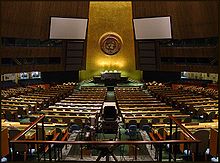
In the 21st Century I believe the mission of the United Nations will be defined by a new, more profound, sensation of the sanctity and dignity of every human life, regardless of race or organized religion...

The sovereignty of States must no longer exist used equally a shield for gross violations of human rights.

The thought that there is i people in possession of the truth, i respond to the world's ills, or one solution to humanity's needs, has washed untold harm throughout history — especially in the last century.
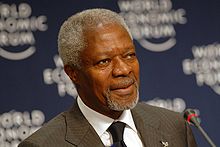
In every corking religion and tradition one can notice the values of tolerance and common understanding

We can love what we are, without hating what — and who — nosotros are non. We can thrive in our ain tradition, fifty-fifty equally we acquire from others, and come to respect their teachings.

The United nations, whose membership comprises almost all the States in the world, is founded on the principle of the equal worth of every human being.
- Today, in Transitional islamic state of afghanistan, a girl volition be born. Her mother will concur her and feed her, comfort her and intendance for her — merely as whatsoever mother would anywhere in the world. In these most basic acts of human nature, humanity knows no divisions.But to be born a girl in today's Afghanistan is to begin life centuries away from the prosperity that one small-scale part of humanity has achieved. It is to live nether atmospheric condition that many of the states in this hall would consider inhuman.
I speak of a girl in Afghanistan, but I might every bit well have mentioned a baby boy or girl in Sierra Leone. No i today is unaware of this divide between the world'south rich and poor. No i today can claim ignorance of the cost that this divide imposes on the poor and dispossessed who are no less deserving of human being nobility, fundamental freedoms, security, food and education than any of us. The toll, however, is non borne by them lonely. Ultimately, information technology is borne by all of the states — North and South, rich and poor, men and women of all races and religions.
Today'south real borders are not between nations, merely between powerful and powerless, costless and fettered, privileged and humiliated. Today, no walls can separate |humanitarian or man rights crises in one part of the globe from national security crises in some other.
- Scientists tell us that the world of nature is and so small and interdependent that a butterfly flapping its wings in the Amazon rainforest tin generate a trigger-happy storm on the other side of the earth. This principle is known equally the "Butterfly Upshot." Today, we realize, possibly more than ever, that the world of homo activity too has its ain "Butterfly Consequence" — for ameliorate or for worse.
- We take entered the third millennium through a gate of fire. If today, later the horror of xi September, we see better, and we see further — we will realize that humanity is indivisible. New threats brand no distinction between races, nations or regions. A new insecurity has entered every mind, regardless of wealth or status. A deeper sensation of the bonds that bind us all — in pain as in prosperity — has gripped young and old.
- The 20th century was peradventure the deadliest in human history, devastated by innumerable conflicts, untold suffering, and unimaginable crimes.Time after time, a grouping or a nation inflicted farthermost violence on another, often driven by irrational hatred and suspicion, or unbounded arrogance and thirst for power and resources. In response to these cataclysms, the leaders of the earth came together at mid-century to unite the nations as never earlier.
A forum was created — the United nations — where all nations could join forces to affirm the dignity and worth of every person, and to secure peace and evolution for all peoples. Here States could unite to strengthen the rule of police, recognize and address the needs of the poor, restrain man'southward brutality and greed, conserve the resources and beauty of nature, sustain the equal rights of men and women, and provide for the safety of time to come generations.
- In the 21st Century I believe the mission of the United Nations volition exist defined past a new, more than profound, awareness of the sanctity and dignity of every man life, regardless of race or faith. This will require us to look beyond the framework of States, and beneath the surface of nations or communities. Nosotros must focus, equally never before, on improving the conditions of the individual men and women who give the country or nation its richness and grapheme.
- Over the past five years, I have often recalled that the United Nations' Charter begins with the words: "We the peoples." What is not always recognized is that "we the peoples" are fabricated up of individuals whose claims to the most key rights accept too ofttimes been sacrificed in the supposed interests of the state or the nation.
- A genocide begins with the killing of ane man — not for what he has done, but considering of who he is. A campaign of 'ethnic cleansing' begins with one neighbor turning on another. Poverty begins when even one child is denied his or her fundamental right to didactics. What begins with the failure to uphold the dignity of ane life, all too often ends with a calamity for entire nations.
In this new century, nosotros must start from the understanding that peace belongs not only to states or peoples, but to each and every member of those communities. The sovereignty of States must no longer be used as a shield for gross violations of human rights. Peace must be made real and tangible in the daily existence of every individual in need. Peace must be sought, above all, because it is the condition for every member of the human family to alive a life of dignity and security.
- The rights of the individual are of no less importance to immigrants and minorities in Europe and the Americas than to women in Afghanistan or children in Africa. They are as fundamental to the poor as to the rich; they are equally necessary to the security of the developed earth as to that of the developing world.
From this vision of the role of the United nations in the adjacent century menses 3 central priorities for the future: eradicating poverty, preventing conflict, and promoting democracy. Only in a earth that is rid of poverty tin can all men and women make the about of their abilities. Just where individual rights are respected tin differences be channelled politically and resolved peacefully. Merely in a democratic surround, based on respect for diversity and dialogue, can individual cocky-expression and self-authorities be secured, and freedom of clan be upheld.
- I humbly accept the Centennial Nobel Peace Prize. Forty years ago today, the Prize for 1961 was awarded for the first time to a Secretary-General of the United Nations — posthumously, because Dag Hammarskjöld had already given his life for peace in Central Africa. And on the same day, the Prize for 1960 was awarded for the first time to an African — Albert Luthuli, one of the earliest leaders of the struggle against apartheid in Due south Africa. For me, as a young African beginning his career in the United Nations a few months later, those 2 men gear up a standard that I have sought to follow throughout my working life.
- In a world filled with weapons of war and all likewise oftentimes words of war, the Nobel Commission has become a vital agent for peace. Sadly, a prize for peace is a rarity in this globe. Most nations have monuments or memorials to war, statuary salutations to heroic battles, archways of triumph. But peace has no parade, no pantheon of victory.
What it does accept is the Nobel Prize — a argument of hope and courage with unique resonance and authority. Only by understanding and addressing the needs of individuals for peace, for nobility, and for security tin can we at the United Nations promise to live up to the honour conferred today, and fulfil the vision of our founders. This is the broad mission of peace that United nations staff members acquit out every 24-hour interval in every role of the earth.
- The idea that there is one people in possession of the truth, 1 respond to the globe'due south ills, or 1 solution to humanity'southward needs, has washed untold harm throughout history — especially in the last century. Today, all the same, even among standing indigenous disharmonize effectually the world, there is a growing understanding that human diverseness is both the reality that makes dialogue necessary, and the very basis for that dialogue.
We sympathize, every bit never before, that each of us is fully worthy of the respect and dignity essential to our common humanity. Nosotros recognize that we are the products of many cultures, traditions and memories; that mutual respect allows us to report and larn from other cultures; and that nosotros gain strength past combining the strange with the familiar.
- In every neat faith and tradition i can detect the values of tolerance and mutual agreement. The Qur'a, for example, tells us that "We created you from a single pair of male and female and made you lot into nations and tribes, that you may know each other." Confucius urged his followers: "when the good way prevails in the state, speak boldly and human activity boldly. When the state has lost the way, human activity boldly and speak softly." In the Jewish tradition, the injunction to "love thy neighbor as thyself," is considered to be the very essence of the Torah.
This idea is reflected in the Christian Gospel, which also teaches us to dearest our enemies and pray for those who wish to persecute us. Hindus are taught that "truth is i, the sages give information technology various names." And in the Buddhist tradition, individuals are urged to act with pity in every facet of life.
Each of us has the correct to have pride in our particular faith or heritage. But the notion that what is ours is necessarily in conflict with what is theirs is both false and unsafe. Information technology has resulted in endless enmity and disharmonize, leading men to commit the greatest of crimes in the name of a college power.
It demand not be so. People of different religions and cultures live side by side in well-nigh every part of the world, and about of us take overlapping identities which unite u.s. with very different groups. We can honey what we are, without antisocial what — and who — we are non. We can thrive in our own tradition, even as nosotros learn from others, and come up to respect their teachings.
- The lesson of the past century has been that where the nobility of the private has been trampled or threatened — where citizens have not enjoyed the basic right to choose their government, or the right to modify it regularly — disharmonize has as well often followed, with innocent civilians paying the price, in lives cut short and communities destroyed.
The obstacles to democracy have little to do with culture or faith, and much more to do with the desire of those in ability to maintain their position at whatsoever cost. This is neither a new phenomenon nor one bars to whatsoever detail office of the globe. People of all cultures value their freedom of option, and experience the need to have a say in decisions affecting their lives.
- The United nations, whose membership comprises almost all us in the world, is founded on the principle of the equal worth of every human being. Information technology is the nearest thing we have to a representative institution that can address the interests of all states, and all peoples. Through this universal, indispensable instrument of homo progress, States can serve the interests of their citizens past recognizing common interests and pursuing them in unity.
- This era of global challenges leaves no selection but cooperation at the global level. When States undermine the rule of law and violate the rights of their individual citizens, they become a menace non only to their ain people, just also to their neighbours, and indeed the world. What nosotros demand today is amend governance — legitimate, democratic governance that allows each individual to flourish, and each State to thrive.
- Beneath the surface of states and nations, ideas and language, lies the fate of individual human beings in demand. Answering their needs will be the mission of the United Nations in the century to come.
Truman Library address (2006) [edit]
- Address at the Truman Presidential Museum and Library, Independence, Missouri, USA (11 December 2006)

In today'southward earth, the security of every 1 of united states of america is linked to that of everyone else.

I believe we accept a responsibility non merely to our contemporaries but as well to future generations — a responsibility to preserve resources that belong to them besides as to us, and without which none of us tin survive.

We are not only all responsible for each other'south security. We are too, in some measure, responsible for each other'south welfare.

Both security and development ultimately depend on respect for human rights and the rule of law.
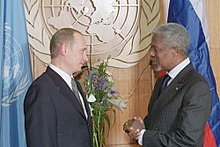
Throughout history, human being life has been enriched by diversity, and different communities have learnt from each other.

Information technology is just through multilateral institutions that States tin concur each other to business relationship.

My friends, our challenge today is not to save Western culture — or Eastern, for that matter. All civilization is at stake, and we can save it only if all peoples join together in the chore.
- In today's world, the security of every one of u.s. is linked to that of everyone else.
- No nation can make itself secure past seeking supremacy over all others. We all share responsibility for each other's security, and only by working to make each other secure can we hope to reach lasting security for ourselves.
— And, I would add together that this responsibility is not simply a affair of States being ready to come to each other's help when attacked — important though that is. It also includes our shared responsibility to protect populations from genocide, war crimes, ethnic cleansing and crimes against humanity — a responsibility solemnly accepted by all nations at last year's United nations world summit. That means that respect for national sovereignty can no longer be used as a shield past Governments intent on massacring their own people, or every bit an excuse for the rest of united states of america to practise zilch when heinous crimes are committed.
- When I look at the murder, rape and starvation to which the people of Darfur are existence subjected, I fear that we have not got far beyond "lip service". The lesson hither is that arty doctrines like the "responsibleness to protect" will remain pure rhetoric unless and until those with the power to intervene effectively — by exerting political, economic or, in the final resort, military machine muscle — are prepared to have the lead.
- I believe nosotros have a responsibleness not simply to our contemporaries only as well to future generations — a responsibility to preserve resources that belong to them likewise every bit to usa, and without which none of the states can survive. That means we must do much more, and urgently, to forestall or slow down climate change. Everyday that we do nothing, or also niggling, imposes higher costs on our children and our children's children. Of course, it reminds me of an African proverb — the earth is non ours just something we hold in trust for futurity generations. I hope my generation will exist worthy of that trust.
- We are not only all responsible for each other's security. We are also, in some measure, responsible for each other's welfare. Global solidarity is both necessary and possible. — It is necessary because without a mensurate of solidarity no society tin exist truly stable, and no one'south prosperity truly secure. That applies to national societies — as all the smashing industrial democracies learned in the twentieth century — only, it also applies to the increasingly integrated global marketplace economy that we live in today. It is non realistic to think that some people tin keep deriving corking benefits from globalization while billions of their swain human beings are left in abject poverty, or even thrown into it. We have to give our young man citizens, not but within each nation but in the global community, at to the lowest degree a chance to share in our prosperity.
- Both security and development ultimately depend on respect for human rights and the dominion of law.
— Although increasingly interdependent, our globe continues to be divided — not only past economic differences, merely also by religion and civilisation. That is non in itself a problem. Throughout history, homo life has been enriched by diversity, and different communities accept learnt from each other. But, if our different communities are to alive together in peace we must stress as well what unites the states: our common humanity, and our shared conventionalities that human dignity and rights should be protected by law.
- Man rights and the dominion of law are vital to global security and prosperity. As Truman said, "We must, in one case and for all, bear witness past our acts conclusively that Right Has Might". That's why this state has historically been in the vanguard of the global man rights move. Merely that lead can only be maintained if America remains true to its principles, including in the struggle confronting terrorism. When it appears to abandon its ain ideals and objectives, its friends away are naturally troubled and confused.
— And States demand to play by the rules towards each other, besides as towards their own citizens. That can sometimes be inconvenient, only ultimately what matters is not inconvenience. It is doing the right thing. No State can make its own actions legitimate in the eyes of others. When power, particularly war machine force, is used, the globe will consider it legitimate just when convinced that it is beingness used for the right purpose — for broadly shared aims –- in accordance with broadly accepted norms.
— No community anywhere suffers from as well much dominion of police; many practice suffer from too little — and the international community is amongst them. This we must modify.
- The U.s. has given the world an instance of a democracy in which everyone, including the most powerful, is discipline to legal restraint. Its current moment of world supremacy gives information technology a priceless opportunity to entrench the same principles at the global level.
- Governments must be accountable for their actions in the international arena, too every bit in the domestic one.
— Today, the actions of 1 Land tin can oft have a decisive issue on the lives of people in other States. Then does it not owe some account to those other States and their citizens, besides as to its own? I believe information technology does.
— Every bit things stand, accountability between States is highly skewed. Poor and weak countries are easily held to account, because they need foreign aid. But large and powerful States, whose deportment accept the greatest touch on others, can be constrained only by their ain people, working through their domestic institutions.
— That gives the people and institutions of such powerful States a special responsibility to accept account of global views and interests, as well as national ones. And today they need to take into account also the views of what, in UN jargon, we phone call "non-State actors". I mean commercial corporations, charities and pressure groups, labor unions, philanthropic foundations, universities and call back tanks — all the myriad forms in which people come together voluntarily to call back about, or try to change, the globe.
— None of these should exist allowed to substitute itself for the State, or for the democratic process past which citizens choose their Governments and decide policy. Merely, they all have the capacity to influence political processes, on the international besides as the national level. States that effort to ignore this are hiding their heads in the sand.
- It is but through multilateral institutions that States can agree each other to account. And that makes it very important to organize those institutions in a fair and democratic way, giving the poor and the weak some influence over the actions of the rich and the potent.
- I have continued to press for Security Council reform. But, reform involves ii split bug. Ane is that new members should be added, on a permanent or long-term basis, to give greater representation to parts of the world which have limited vocalization today. The other, perhaps even more of import, is that all Council members, and especially the major powers who are permanent members, must accept the special responsibility that comes with their privilege. The Security Council is not just another stage on which to human action out national interests. It is the management committee, if y'all will, of our fledgling collective security arrangement.
- My friends, our challenge today is not to save Western civilization — or Eastern, for that thing. All civilization is at stake, and we can save information technology only if all peoples bring together together in the task.
You Americans did so much, in the last century, to build an constructive multilateral organisation, with the United nations at its heart. Do you demand it less today, and does it demand you less, than 60 years ago?
Surely not. More than ever today, Americans, like the rest of humanity, need a functioning global system through which the world's peoples can face global challenges together. And in order to function more effectively, the arrangement still cries out for far-sighted American leadership, in the Truman tradition.
I hope and pray that the American leaders of today, and tomorrow, will provide it.
Farewell Speech (2006) [edit]
- Fair-well voice communication after finishing his term as Secretary of the United nations (11 December 2006)
- Thank you, Senator [Hagel] for that wonderful introduction. It is a groovy honour to be introduced by such a distinguished legislator.
- And thanks to you, Mr Devine, and all your staff, and to the wonderful UNA chapter of Kansas City, for all you lot take done to make this occasion possible.
- What a pleasance, and a privilege, to be hither in Missouri. It is almost a homecoming for me. Nigh half a century ago I was a student almost 400 miles north of here, in Minnesota.
- I arrived there straight from Africa - and I tin can tell yous, Minnesota before long taught me the value of a thick overcoat, a warm scarf and even ear-muffs!
- When you leave one abode for another, there are ever lessons to be learnt'. And I had more to learn when I moved on from Minnesota to the United Nations - the indispensable mutual house of the unabridged human family, which has been my main home for the last 44 years.
- Today I want to talk specially nearly v lessons I accept learnt in the last 10 years, during which I have had the difficult only exhilarating role of Secretary General.
- I think it is specially plumbing equipment that I do that here in the firm that honours the legacy of Harry S Truman. If FDR [Franklin D Roosevelt] was the architect of the United Nations, President Truman was the master-builder, and the faithful champion of the Organization in its first years, when information technology had to face quite different issues from the ones FDR had expected.
- Truman'south name will for e'er be associated with the memory of far-sighted American leadership in a nifty global endeavour. And you will see that every one of my five lessons brings me to the conclusion that such leadership is no less sorely needed now than it was 60 years ago.
Quotes nigh Annan [edit]
- We not only have confidence in him, we support him fully. He is in a very hard job under very difficult circumstances, but we continue to have promise that he is doing his all-time. Nosotros only desire his senior management to exhibit the transparency and accountability that he has proscribed for the system.
- Rosemarie Waters, president of the United Nations Staff Marriage [ane]
- We in Europe hold Kofi Annan in high esteem and recognise his unstinting efforts in the cause of peace and democracy.
- Jacques Chirac
- The American view of the Un is broadly that it is a identify where they can make their viewpoint and their interests felt. It was they who insisted that Boutros Boutros-Ghali stride down and the present Secretary-General, Mr Kofi Annan, supersede him. Kofi Annan is an American selection and equally a compromise he was accepted past the other nations. The Americans idea he would be a weak person, but since he shows independence they now want him to become. He is wise and just. He does non want to offend America.
He knows that if America does not become its own manner in the United nations then information technology does not pay its dues. Each pays a proportion according to their Gross National Product. Considering of the size of America and the hugeness of its Gross National Product America pays more anybody else. And then that when they do not pay, it curtails incredibly the activity of the Un. Kofi Annan, of course, is responsible, as he is the Secretary-Full general, for making sure that the countries pay their dues, so he is 'blackmailed' by the United states of america and others. There are but virtually three who practise so rapidly and keep up-to-date, without existence asked: Holland, Norway and Canada. The residuum play power politics: "We will give information technology when y'all exercise what we say." And so Kofi Annan is always having to steer a grade that does not upset the balance of power.- Benjamin Creme in Questions & Answers, Share International (May 2005)
- We are non suggesting or pushing for the resignation of the secretarial assistant-general. Nosotros have worked well with him in the past and look forward to working with him for some fourth dimension in the future.
- United States ambassador John Danforth [ii]
- Both Bush-league besides as Tony Blair are undermining an idea [the Un]. Is this because the secretarial assistant general of the United Nations [Ghanaian Kofi Annan] is now a black human being? They never did that when secretarial assistant generals were white.
- Nelson Mandela
External links [edit]

- Official United nations biography
- Nobel Peace Prize biography
- Kofi Annan: Center of the Storm (PBS)
- Kofi Annan: An Online News Hour Focus
- Kofi Annan, President, Global Humanitarian Forum
- Kofi Annan: Profile past Phyllis Bennis of the Global Policy Forum
- "One-on-1 with Un Secretarial assistant-General Kofi Annan " (October 1998)
- Annan Commodity in Saga Magazine
- Profile at the Africa Progress Panel
- "U.N. Primary's Record Comes Under Burn" by Colum Lynch, in The Washington Post (24 April 2005)
- "Annan has paid his dues: The UN declaration of a right to protect people from their governments is a millennial alter" by Ian Williams, in The Guardian (xx September 2005)
- "Lessons from the U.N. leader" in The Washington Postal service (12 December 2006)
- "Kofi and U.N. Ethics" in The Wall Street Periodical (14 December 2006)
- Statements of Secretary-General Kofi Annan
- Nobel Peace Prize lecture
- In Truman Library voice communication, Annan says UN remains all-time tool to achieve key goals of international relations (11 December 2006)
- The Kofi Annan Foundation
Source: https://en.wikiquote.org/wiki/Kofi_Annan

Postar um comentário for "Kofi Annan Great Tragedy Most Vulnerable Human Family"